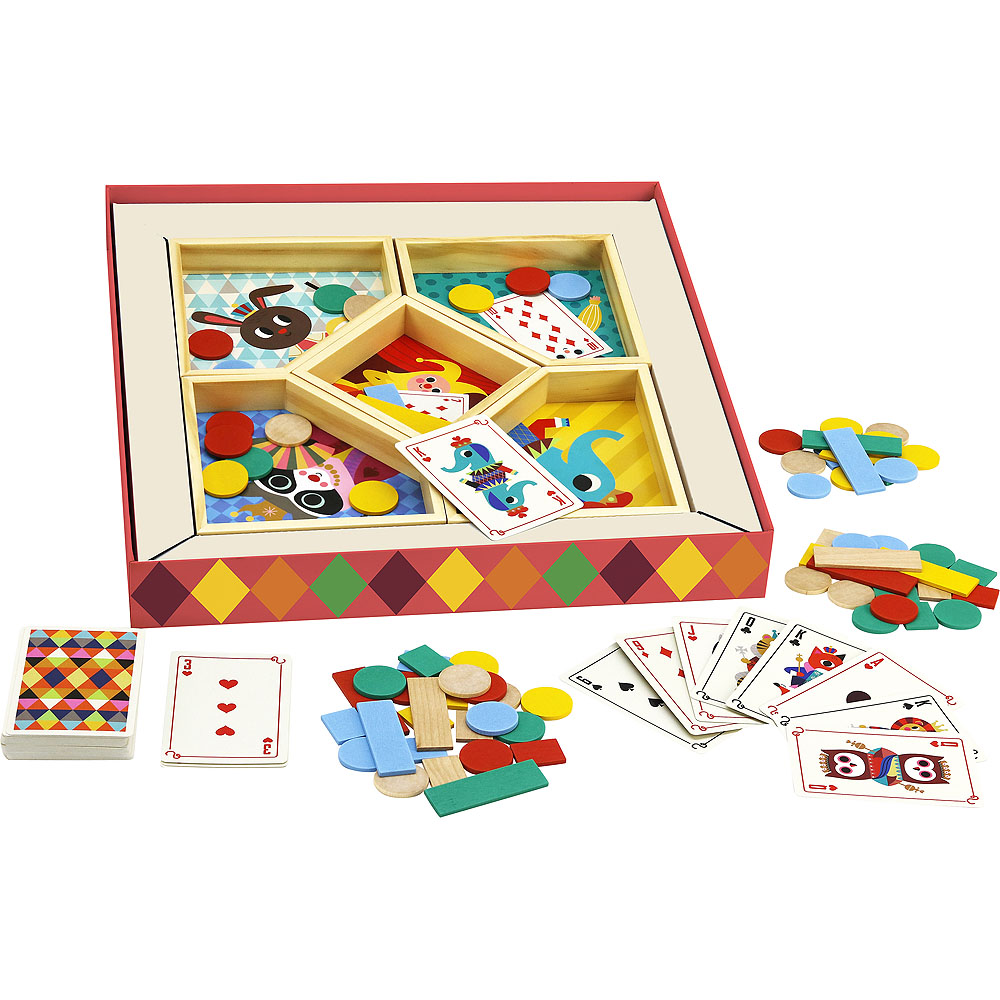
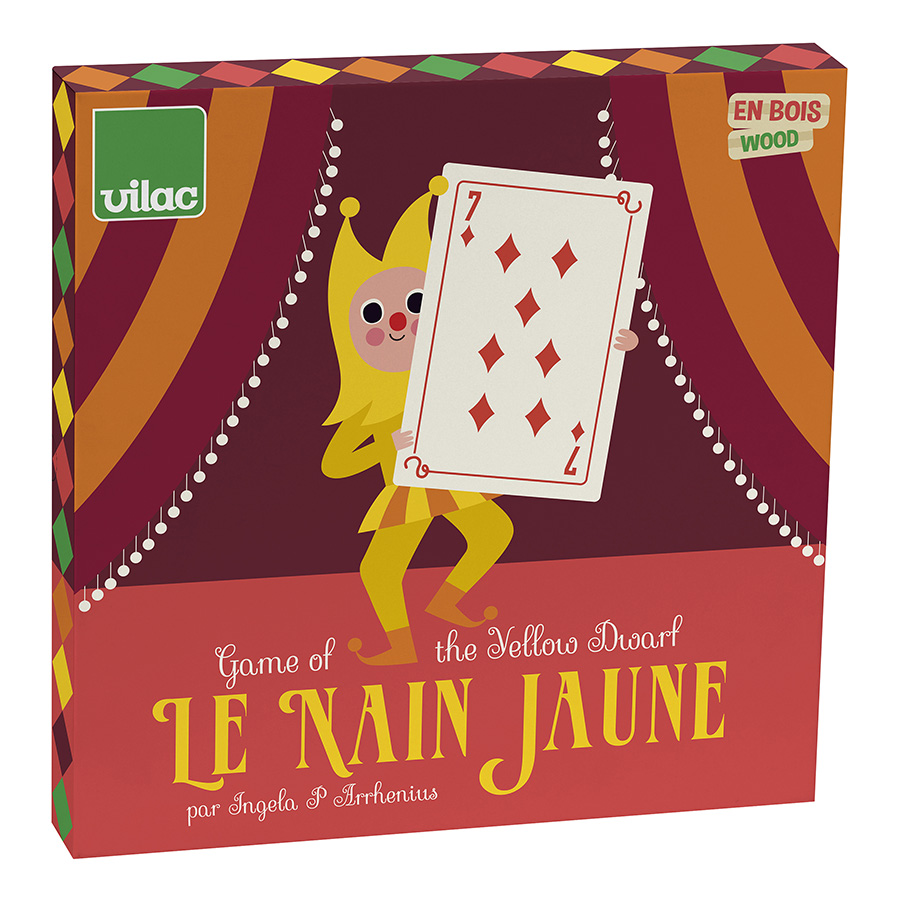


The Yellow Dwarf (Nain Jaune), also known as Lindor, is a classic French card game popular for its accessibility, especially as a family pastime. Be enchanted by the design with solid wood parts and attractive illustrations by Ingela P. Arrhenius. The set includes a standard pack of whist (poker) cards, which you can use with the tokens for many other card games. Main features: for 3–8 players5 game boxes, 54 cards and 85 tokenssolid wood partsdesign Ingela P. Arrhenius Game rules:At the beginning, the players are divided into the same number of tokens of three values (ten-point, five-point and one-point) depending on how many players are playing and how many rounds you want to play (more tokens means more rounds and a longer game). Then, at the beginning of each round, the players divide 15 of their tokens into boxes, to ♦10 belongs a token for each player, ♣J 2 tokens, ♠Q 3 tokens, ♥K 4 tokens and 5 tokens for ♦7 (yellow dwarf). The tokens that remained in the boxes from the previous rounds are left and added to the next round of the game. In the next step and at the beginning of each round, you select (draw) a dealer who deals the entire deck of cards among the players (usually three at a time). Counter-clockwise, to the right of the dealer, the first player begins by discarding any card onto the playing surface (for example, a 5) and continues discarding in ascending numerical order regardless of the suit of the cards (6, 7, …), until they are missing the next card in the sequence – they announce its value to the other players. The next player in turn then tries to build on the numerical sequence and continue discarding cards in sequence. The player who completes the sequence by discarding the King starts a new sequence with a card of their choice. If none of the players is able to complete the numerical sequence, the player who discarded the last card starts a new sequence with a card of their choice. If a player currently has a card to discard that is represented in the five boxes on the playing surface (♦10, ♣J, ♠Q, ♥K, ♦7), and intends to use it, they must announce this to the other players (using a pre-arranged call) and, upon discarding the card, they will receive the tokens bet on it. If a player does not intend to use such a card, or forgets to announce it, the bet is forfeited and remains in the box until the next round of the game. A player who still holds one of the five cards at the end of the round must (among other things) add as many tokens to the corresponding box as are currently in it. The winner of the round is the player who is the first to discard all of their cards. The others must pay them an amount of tokens corresponding to the value of the cards they have left in their hands (face card 10 points, ace 1 point, other cards according to their value). If one of the players manages to discard all the cards at once (the so-called "opera"), they win all the tokens from the boxes on the playing surface in addition to the tokens from the other players. A player who is unable to bet the appropriate number of tokens into the boxes at the beginning of the round (the total sum of their tokens has fallen below 15) is eliminated from the game. The winner is ultimately the player with the most tokens. Swedish artist Ingela Peterson Arrhenius was born in 1967. Art and design have always had a place in her life, and before her career as an illustrator began, Ingela worked as an art director in Stockholm. She then studied advertising and graphic design at an art school also in Stockholm. In 1992, she started working as a freelance illustrator and worked internationally across advertising, design, publishing… In the past, she has created print patterns for fabrics, wallpapers, stationery, and has also worked on packaging, product design, home accessories and toys. Her posters and designer toys can be found all over the world. She has a passion for retro style, which is clearly visible in her works and also in her enthusiasm for typography and colours. She now lives in Stockholm with her husband and 2 sons.
Sizing info
Vilac is proud to work closely with ADEME, a French government organisation involved in a wide range of activities leading to environmental protection. The history of this agency dates back to the 1970s, to the time of the oil crisis. It actively collaborates with politicians, public organisations, the private sector and citizens. It is behind recommendations, proposals for technical, methodological and financial procedures, studies and awareness campaigns. Thanks to its many years of operation, ADEME is recognised as a credible third party providing guarantees of efforts towards a sustainable future. By purchasing a product from a manufacturer cooperating with this agency, the customer can express their will to preserve the environment through strictly assessed procedures and key innovations throughou