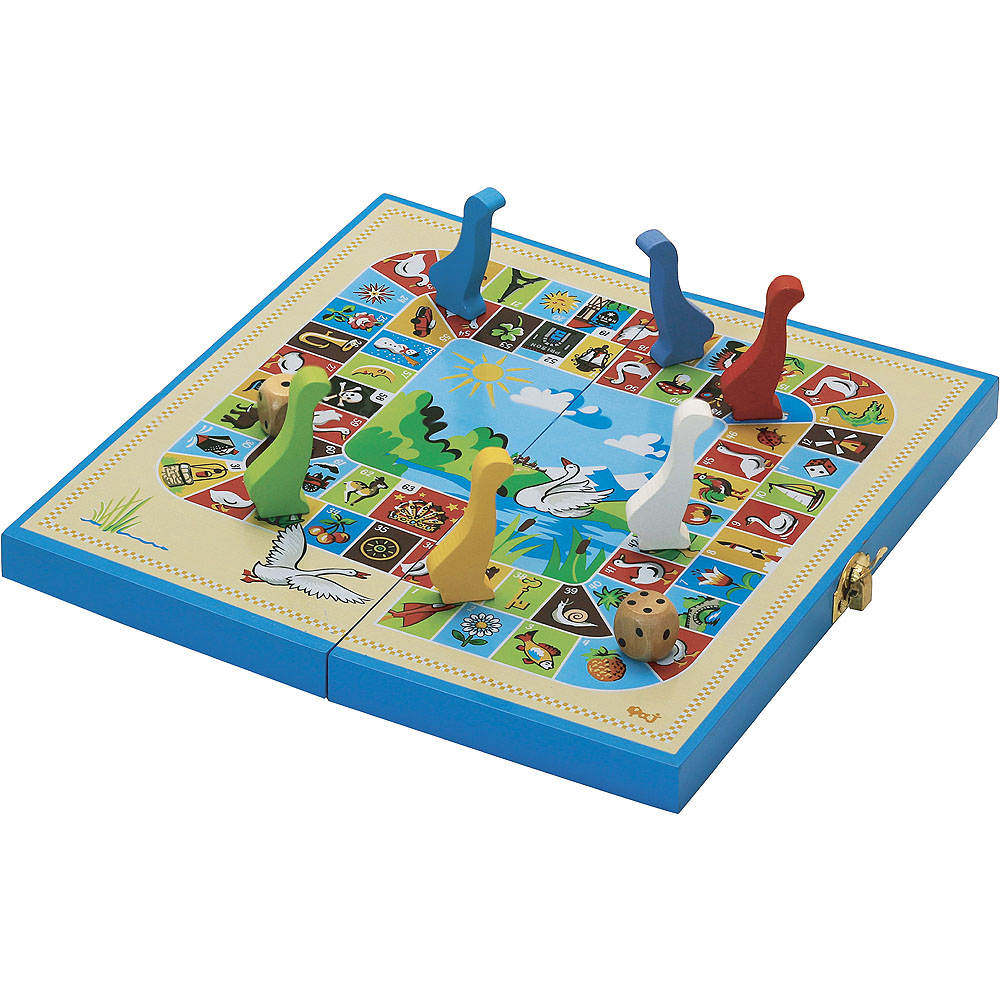
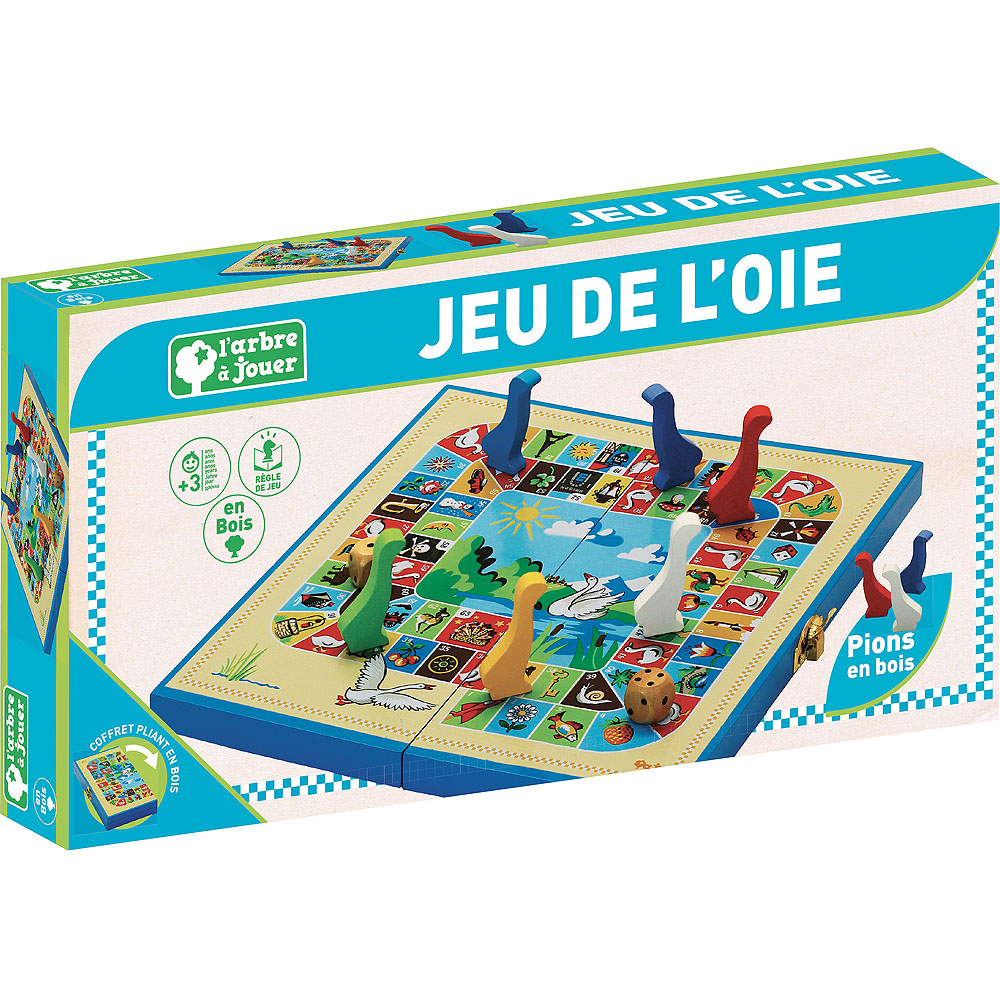


A classic French board game for 2–6 players in a traditional travel version, made from solid wood. Main features:for 2–6 playersall components made of solid woodpractical packaging Game rules: The aim of the game is to reach the winning square no. 63. Before starting the game, each player chooses their goose piece. Then each of them rolls both dice at the same time. The player who rolls the highest number starts. Move the pieces by the number of spaces shown on the dice. If you land on a square with a picture of a goose, you're in luck – move your piece again by the same number of spaces. If you roll a six and a three on your first turn, move to square no. 26.If you roll a four and a five, move to square no. 53.If you land on square no. 6, move to square no. 12."He who goes hunting loses his place…" On square no. 22, you must move 3 squares back.To get out of the well on square no. 30, you must roll a six.On square no. 35, you arrive at the hotel, miss one turn.The maze on square no. 42 sends you back to square no. 31.In prison, on square no. 52, you miss two turns.On square no. 58, you get lost in the dungeon and must return to the start.If you roll a number that would take you past square no. 63, you must move back that many squares on the game board.
Sizing info
The roots of Jeujura date back to 1911, when Henri Liégeon founded his woodworking shop in Champagnole in the Jura Mountains. The company was engaged in the production of everyday objects, such as tool handles or folding chairs and deck chairs. When the founder's son, Bernard Liégeon, was entrusted with the management in 1931, the company reoriented itself to the production of wooden games, toys, but also abacuses. Inspired by the charm of mountain chalets, Bernard Liégeon later introduced his own type of wooden building kit, which soon made the company famous. In 1948, Jeujura was founded on these foundations.
In the 1970s, under the leadership of the third generation of the Liégeon family, the company succeeded in establishing itself not only on the French but also on foreign markets. Emphasis was placed on the continuous development of products and their thematic extensions. In the early 1980s, the company moved to its own premises not far from its birthplace and, at the same time, added variety and colour to the products and packaging. A decade later, already under the leadership of the founder's great-granddaughter Catherine Varacca, the company invested heavily in machinery and the expansion of space. And not long after Jeujura celebrated its centenary with the release of collector's series of its toys, it received the state award “Entreprise du Patrimoine Vivant”, which is intended for French companies preserving cultural heritage, outstanding craftsmanship and industrial know-how. At the same time, the company joined forces with other traditional French toy manufacturers, Petitcollin and Vilac.
Jeujura continues to develop and annually introduces new, authentic toys, games and aids for young and old.
Manufacturer's address and contact:
VILAC S.A.S.
MOIRANS-EN-MONTAGNE CEDEX
39261
France
info@vilac.com
.slideshow {width: 100%;position: relative;max-width: 100%;}
.slideshow img {position: absolute;top: 0;left: 0;width: 100%;opacity: 0;filter: alpha(opacity=0);transition: opacity 4s;border-radius:4px;}
.slideshow .show {opacity: 1;filter: alpha(opacity=100);}
.slideshow :first-child {position: relative; display: block;}
(function(el, time) {var timer;var active = 0;var img = el.querySelectorAll("img");var imgCount = img.length;function change() {img[active].className = "";if (active == (imgCount – 1)) {active = 0;}else {active = active + 1;} img[active].className = "show";} timer = setInterval(change, time);})(document.querySelector(".slideshow"), 5000)