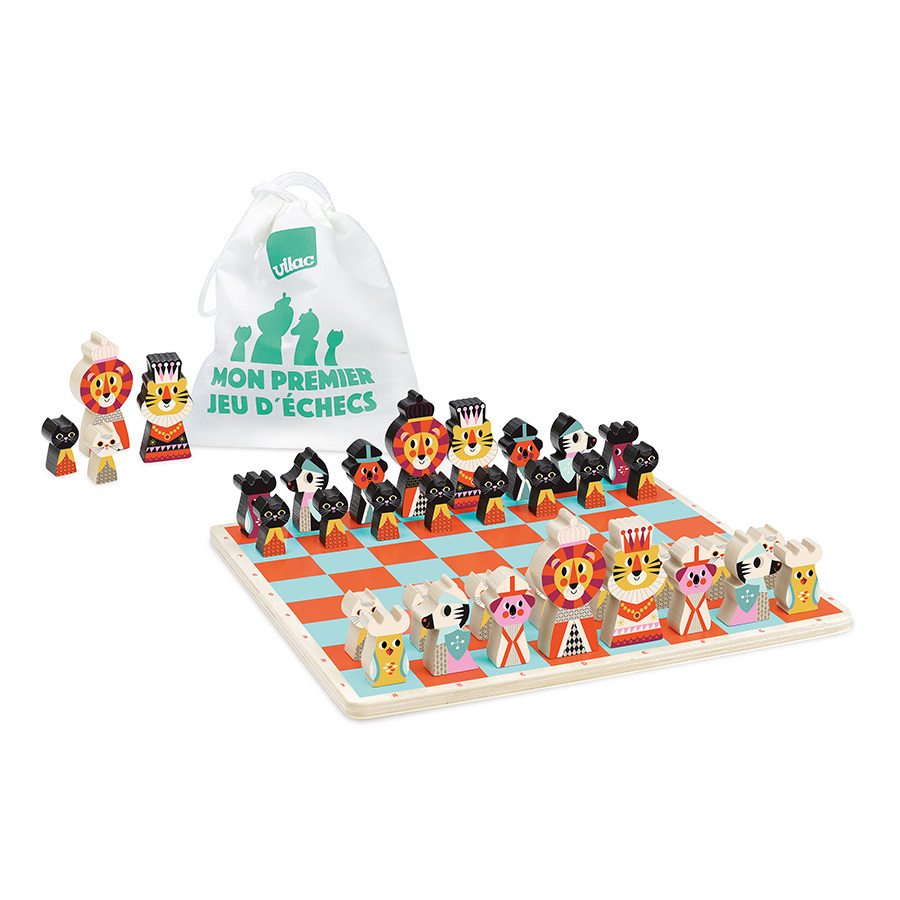
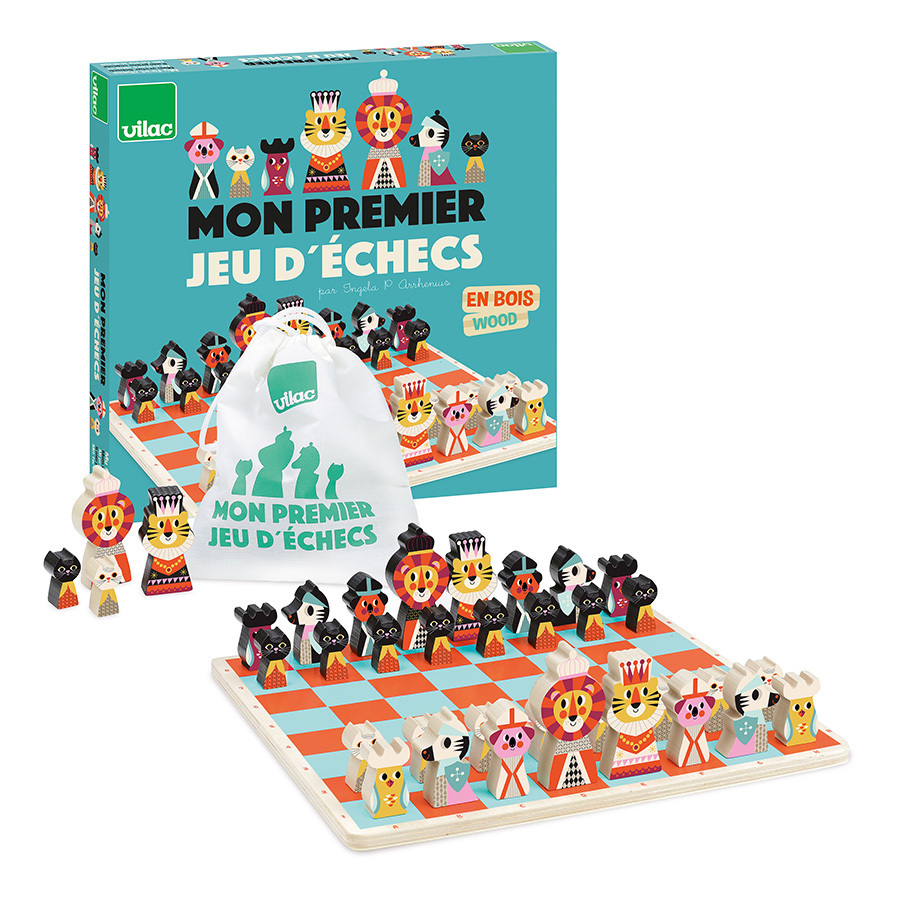
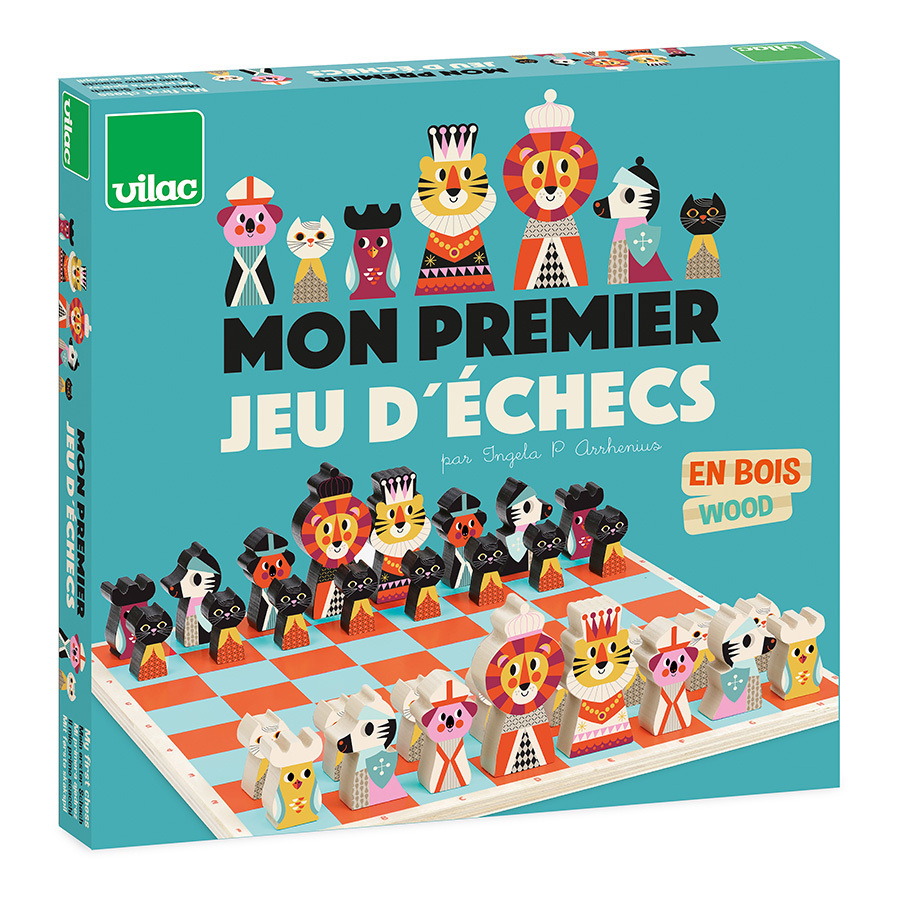
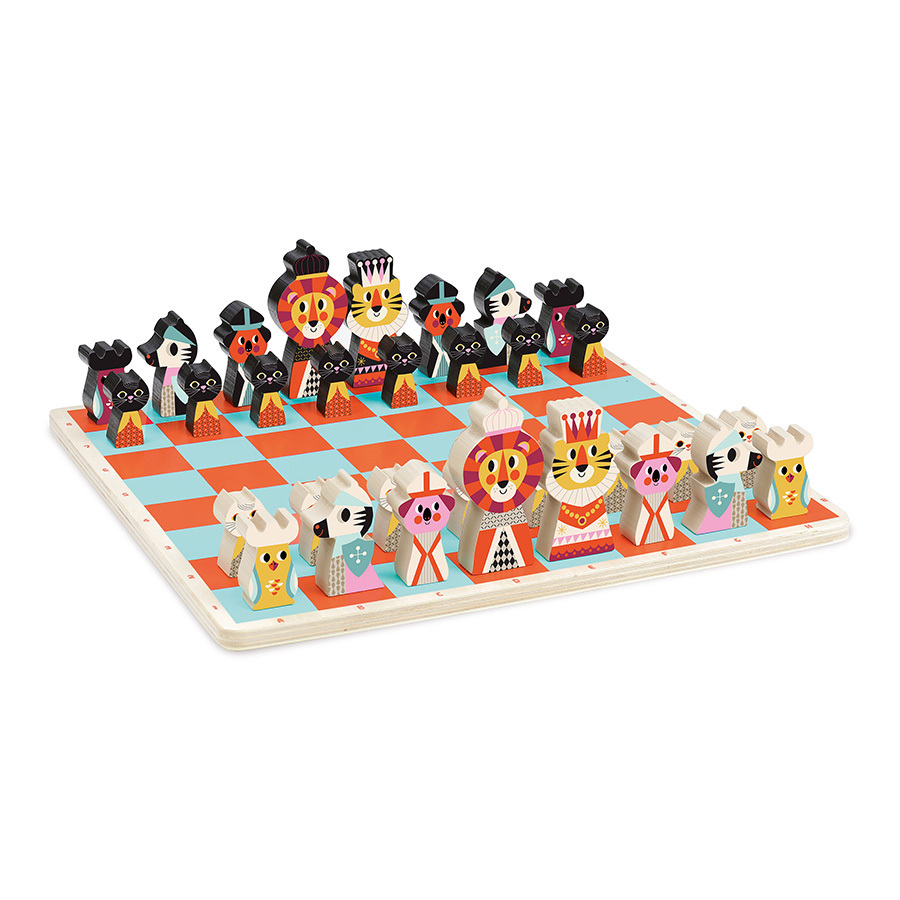
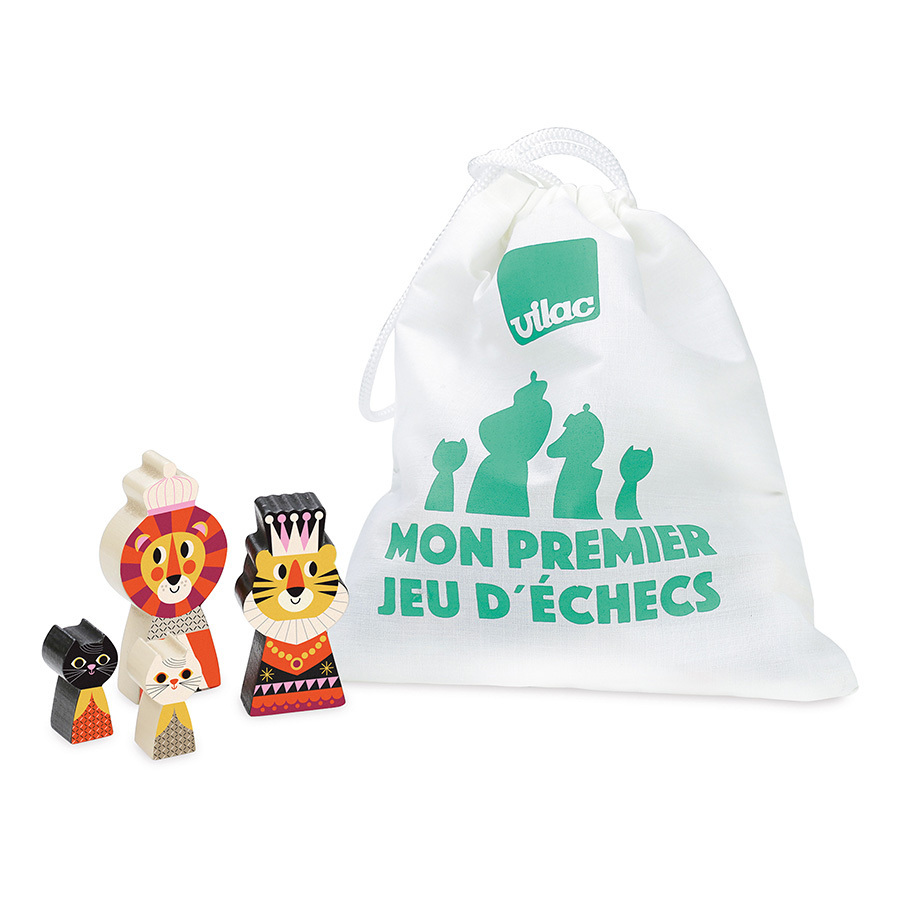
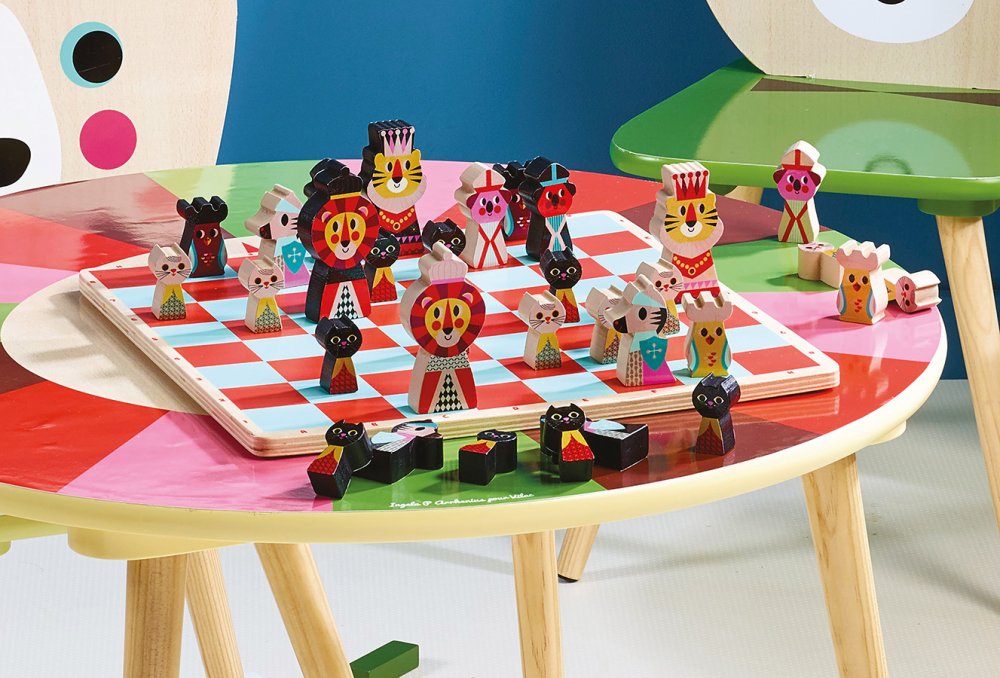
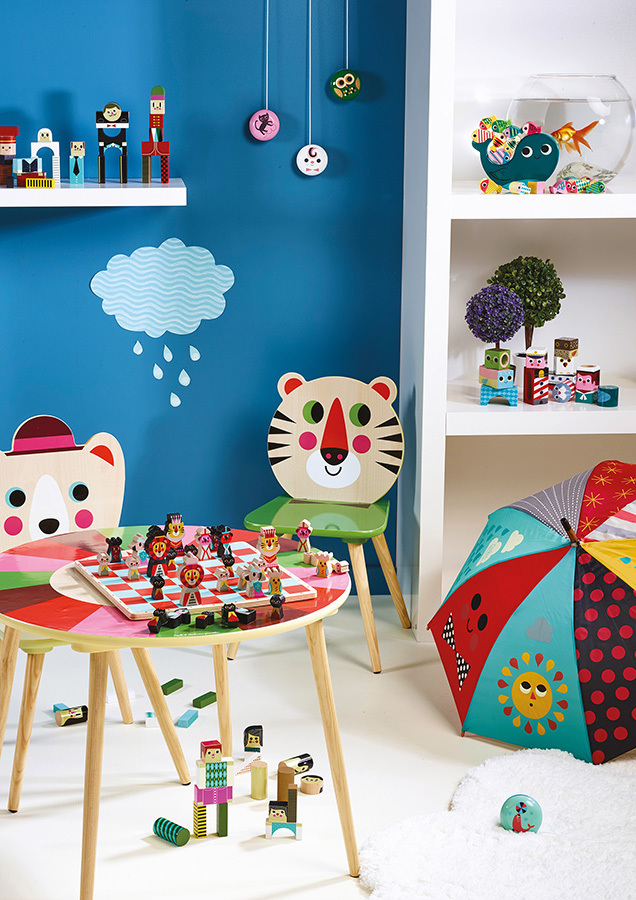

Colourful chess for the little ones with wooden animal figures. They easily capture the attention of children, making it easier for them to grasp the principle of the game. The figures are stored in a fabric bag. The package contains 32 pieces. Illustrated by Ingela P. Arrhenius. Main features: wooden game board and figurescolourful game stimulates children's sensesdesign by Ingelou P. Arrhenius Game instructionsGame contents: game board16 black and 16 white chess piecescotton bag Two players, "black" and "white", have 15 other pieces besides their king: a queen, 2 bishops, 2 knights, 2 rooks and 8 pawns. Starting position:At the beginning of the game, the pieces are arranged as in picture no. 1, which can be found in the original instructions in the package.The king always stands on square E, the queen on square D. The white player starts, then the players take turns one move at a time. A player can never give up their turn. No move may move a piece to a square already occupied by another piece of the same colour. The pieces always move to empty spaces, the only exception being when taking an opponent's piece. In this case, the player places their piece on the square where the opponent's piece was captured. The knight is the only piece that can jump over other pieces.Capturing an opponent's piece involves removing that piece from the square and placing the capturing piece on the same square.The aim of the game is to checkmate the opponent's king.Check occurs when you attack the opponent's king with a move, meaning you move a piece so that it could potentially capture the king on the next move; this is called check. If such a situation arises, the opponent is obliged to play in such a way as to avert this threat. For example, move the king to a square that is not attacked, or place another piece in front of the king to deflect the attack, or capture the attacking piece.If there is no move that complies with the rules, it means checkmate, i.e. the end of the game and the victory of the player who delivered checkmate. According to the rules, the king piece cannot be captured; therefore, in checkmate, it is laid flat on the board. How the individual pieces move:The game is interesting because each piece moves differently. KingIt can move one square in all directions, but not, of course, to squares that are threatened by the opponent's pieces. Two kings can never be on adjacent squares. The aim of the game is to check the opponent's king. The King can never be taken. If a player attacks their opponent's King, they must warn them by saying "check." QueenIt is the most powerful piece because it can move in all directions, any number of squares. However, it must not jump over another piece. KnightThe Knight does not move in a straight line, like the other pieces, but from one square to another, in the shape of the letter L. It can jump over its own and its opponent's pieces. When moving, it first moves two squares forward, backward, left or right, and then one square to the left, right, up or down, so as to copy the letter L with its movement. But never diagonally. See the picture in the instructions. BishopIt moves and takes pieces diagonally. It can move as many squares as it wants, but only in one direction per move. It must not jump over pieces. The movement along diagonals implies that no move can change the colour of the square on which the bishop stands. RookIt moves horizontally and vertically at any distance. From its square, it can move to one that is either in the same row or the same column. However, it must not jump over any piece that would stand in the way. PawnIt moves one square forward, except for the first move, when it can, if it wants to, move two squares forward. The pawn only moves vertically, except for taking the opponent's pieces, then it moves diagonally, like a bishop. Always one square at a time, though. Once a pawn reaches the 8th square – the opponent's base – it must 'transform' into another piece, according to the player's decision, and into a piece that has been taken by the opponent. The Queen is the best choice if she has already been taken. Swedish artist Ingela Peterson Arrhenius was born in 1967. Art and design have always had a place in her life, and before her career as an illustrator began, Ingela worked as an art director in Stockholm. She then studied advertising and graphic design at an art school also in Stockholm. In 1992, she started working as a freelance illustrator and worked internationally across advertising, design, publishing… In the past, she has created print patterns for fabrics, wallpapers, stationery, and has also worked on packaging, product design, home accessories and toys. Her posters and designer toys can be found all over the world. She has a passion for retro style, which is clearly visible in her works and also in her enthusiasm for typography and colours. She now lives in Stockholm with her husband and 2 sons.
Sizing info
Vilac is