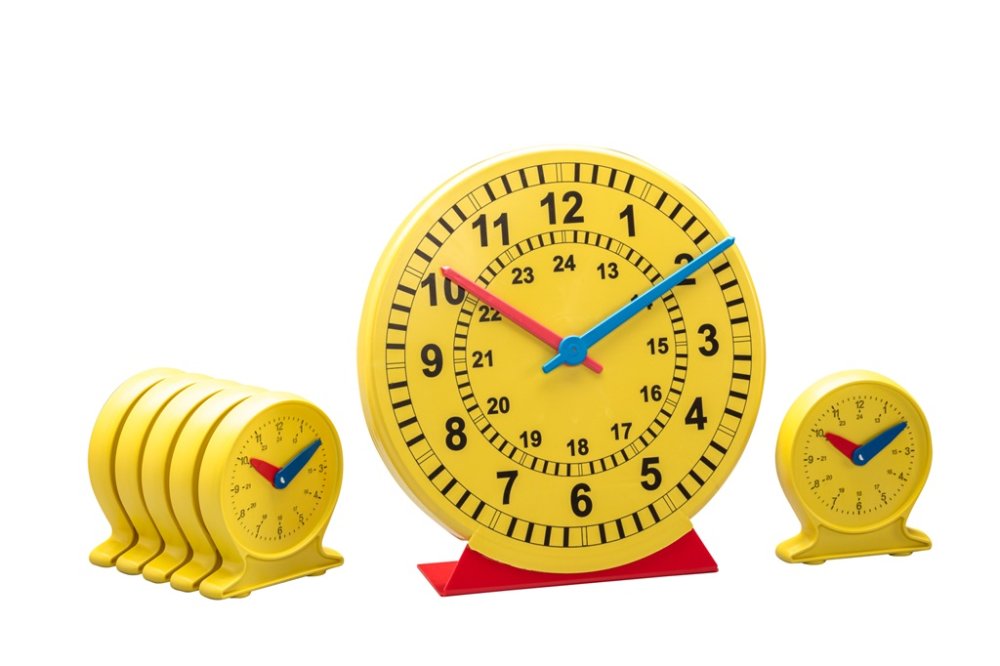
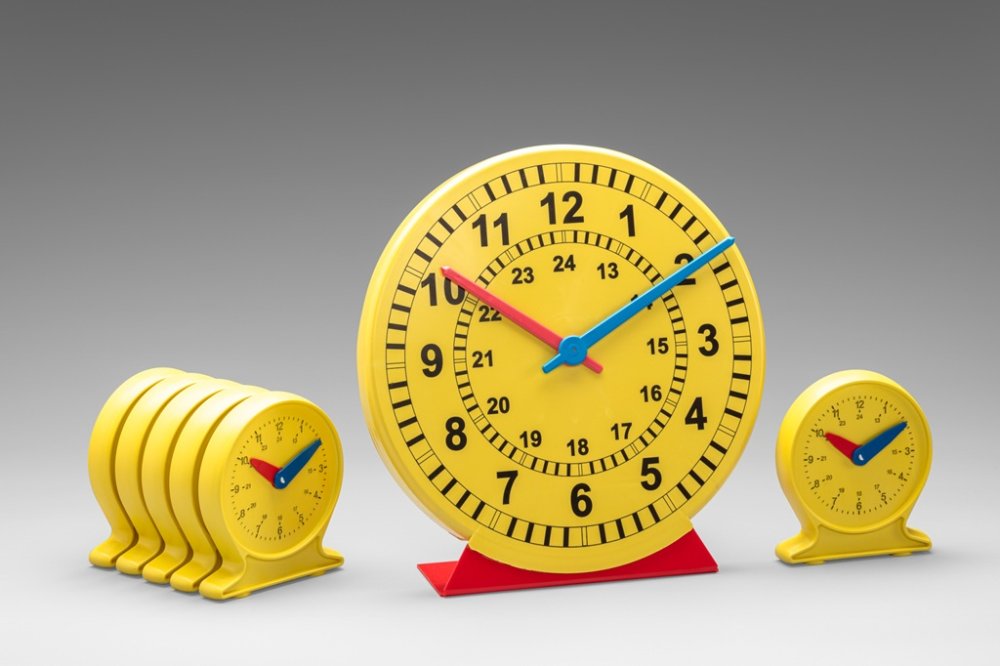


This practical set consists of 24 hours for pupils and a large teacher's clock with a stand. Children have the opportunity to incorporate their own experiences into the topic of time and clocks. They learn to name the numbers on the clock face and the individual hands (hour and minute) and to understand the principle of the 24-hour day, where each hour is repeated twice – morning and afternoon. They also learn the connection between times of day and common activities (e.g. morning – breakfast). Emphasis is placed on distinguishing between a specific point in time and a period of time. Children learn to determine simple time periods based on start and end times, set clock hands, and show whole, half, and quarter hours. At the same time, they practice different ways of writing and reading time using a raised clock face and adjustable, synchronised hands. Other skills include converting time data between different units, recording time values, using measurement data and standardised units. Pupils learn to recognise and solve word problems with time data and approach them according to their individual level and abilities.Made from 100% recycled plastic, which is repeatedly recyclable after use. Main features: 24 hours for students and 1 large clock for teachersincorporating own experiences with the perception of timenaming hands and numbers on the clock faceconnecting times of day with common activitiesdistinguishing between a point in time and a period of timesetting whole, half and quarter hoursreading and writing time in different waysconversions between time unitssolving word problems with timeadapted to the child's level made in Germany
Sizing info
RE-WOOD is an ecological alternative to plastic. It consists of 100% recycled and natural material with PEFC certification. RE-WOOD products are safe, strong, lightweight and saliva-resistant. Wissner has been dedicated to this material for 10 years. It is manufactured in an environmentally friendly way from crushed wood residues (waste product from German woodworking plants) and recycled binder. The material can be composted if given sufficient time to decompose.
All plastic parts of Wissner educational tools are made of RE-PLASTIC material. Its production uses 100% recyclable polystyrene from post-industrial waste. It is recycled on site and then returned to production. RE-PLASTIC can be recycled over and over again, and in terms of quality, appearance and feel, it is a full equivalent of PVC. Environmental protection without sacrificing product quality.
The PEFC (Programme for the Endorsement of Forest Certification) certificate guarantees that the wood from which the product was made comes from forests managed in a careful and sustainable manner, and that the highest environmental, social and ethical standards are observed during logging. PEFC criteria are regularly revised through a process of global consultations involving research organisations, governments, the public, entrepreneurs and employers, taking into account new scientific findings and social changes. The PEFC label on a product indicates that by purchasing it, you are helping to protect forests and supporting careful and responsible management, which will make it possible to preserve forests for future generations.
In 1976, Jürgen Wissner founded a company in Bensheim, Germany, to produce mathematical tools for schools. The motto of the family company, which does not think about quarterly closures but about future generations, is "smart products for bright minds". In 1982, they also added didactic tools for children to their portfolio. The company continued to develop, producing products under the principle of active learning "school through play". Wissner gradually switched from ordinary plastic to recycled plastic, and later, in 2012, took another step towards greener production, replacing plastic materials with 100% recycled wood waste. More than 90% of products are made from these recycled materials. Wissner has also expanded its product line to include linguistic educational toys, didactic tools for traffic education and meteorology, and educational games focusing on mathematics. Since 2015, it has been producing most of its products from recycled wood. In 2018, there were further major changes, from redesigning the company's design, setting new goals and values relating to production and materials used, to producing completely new types of didactic toys. The recycled wood from which Wissner manufactures its products was PEFC certified in 2023. This means that it comes from forests managed in a careful and sustainable way. The recycled material is free of harmful substances, and the wood used, especially sawdust, comes from Germany. The company strives to source as many of the materials used as possible from EU countries. The products are manufactured in German Bensheim and southern Hesse. Wissner manufactures not only useful learning tools, but also educational ga